We offer modern, gentle options to treat cavities early — often without drilling, numbing, or traditional fillings. Here's what they are, how they work, and what to expect.
Which treatment did my child receive?
If your child was seen by OMCDS recently, here's a quick guide to what may have been done — and what it means for their teeth.
✨ Curodont Repair
A clear gel applied to early-stage cavities. No staining. The tooth looks the same after treatment.
💧 Silver Diamine Fluoride (SDF)
A liquid applied to stop more progressed cavities. The treated area will turn dark or black — this is expected and means it's working.
✨
Early cavity repair
Curodont Repair New
Curodont Repair is a biomimetic treatment — meaning it works with the tooth's natural biology to rebuild weakened enamel. It's our preferred first option when cavities are caught early, especially for kids.
How it works
A clear gel is applied to the early cavity. The active ingredient (P11-4) self-assembles into a scaffold inside the tooth, attracting calcium and phosphate from saliva to rebuild enamel naturally.
Best for
Early-stage cavities, "white spot" lesions, and areas where enamel is weakening but hasn't fully broken down yet. Not suitable for large or deep cavities.
No drilling or numbing needed
Does not stain or discolor the tooth
Pain-free and fast to apply
Helps preserve natural tooth structure
Works best when cavities are caught early
May not be sufficient for larger or deeper cavities
💡This is often our preferred first option when cavities are caught early — especially in children who may be nervous about dental treatment.
→If a cavity is more advanced or has progressed deeper into the tooth, we may use Silver Diamine Fluoride (SDF) to stop it from getting worse.
💧
Cavity arrest
Silver Diamine Fluoride (SDF)
SDF is a liquid that is painted onto a cavity to stop bacteria, arrest decay, and prevent the cavity from getting worse. It has been used safely in dentistry for decades and is especially effective in mobile and community settings.
How it works
The silver kills cavity-causing bacteria, while the fluoride strengthens the remaining tooth structure and forms a hard protective layer over the decayed area.
Best for
Active cavities that have progressed beyond the earliest stage, or when a child needs treatment but isn't ready for drilling. Also used for older patients and those with limited access to care.
Stops cavity progression quickly and effectively
No drilling or numbing needed
Safe for children, seniors, and medically complex patients
The treated cavity will turn dark brown or black permanently
A filling or crown may still be needed later for structural support
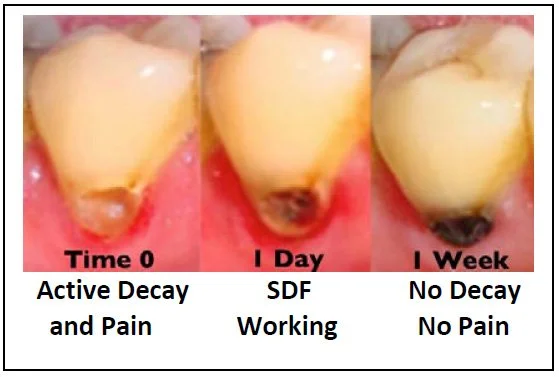
The dark area shows an SDF-treated cavity. This discoloration is expected — it means the decay has been stopped. Healthy tooth structure around it stays its natural color.
⚠️About the black color: SDF will permanently darken the decayed area. This is a known and expected result of the treatment — not damage to the tooth. Healthy enamel around the treated spot will not change color.
📅
After SDF treatment
What to Expect Over Time
1
Immediately after
The treated area begins to darken. This can happen within minutes to hours. It is painless and expected.
2
Days to weeks
The cavity turns dark brown or black as the bacteria are eliminated and the treated area hardens. This is a sign the treatment is working.
3
Follow-up visits
We may re-apply SDF at future visits to ensure the cavity remains arrested. Most teeth with SDF are monitored at each visit.
4
Long-term
The dark color is permanent. Depending on the tooth's location and the patient's needs, a filling, crown, or no further treatment may be recommended down the road.
📊
Side by side
Curodont vs SDF vs Traditional Filling
Not sure which treatment is right? Here's how they compare:
Feature
✨ Curodont
💧 SDF
🔧 Traditional Filling
Drilling required
No
No
Yes
Numbing injection
No
No
Usually
Tooth discoloration
None
Dark/black permanently
None
Best for
Early / white spot cavities
Active / progressed cavities
Moderate to large cavities
Rebuilds enamel
Yes
No
Partially
Stops decay
Early stages
Yes
Yes
Time to apply
~5 minutes
~2 minutes
30–60 minutes
May need follow-up filling
Rarely
Sometimes
No — it is the filling
ℹ️The best treatment depends on the size, location, and severity of the cavity. Our dentist will always explain which option is recommended and why before any treatment begins.
🔧
Setting expectations
When Is a Filling Still Needed?
SDF and Curodont are powerful tools, but they are not always a permanent final solution. A traditional filling may still be recommended in these situations:
The cavity is large enough to affect the tooth's strength or biting surface
The tooth is a permanent tooth that needs long-term structural support
The patient or family prefers to remove the dark staining with a tooth-colored filling
The cavity has progressed to the point where the tooth needs more significant restoration
💬We'll always talk you through the next steps clearly. There is no pressure — we work with families to find the right plan for their child's needs and comfort level.
❓
Parent questions
Frequently Asked Questions
My child's tooth is now black — is that okay?
Yes. If your child received SDF, the dark color is completely expected and means the treatment is working. The decay has been stopped and the area has hardened. Healthy tooth structure around it will not change color.
Will the black color go away?
No — the dark color from SDF is permanent. If the tooth is a baby tooth, it will eventually fall out naturally. For permanent teeth, a filling can be placed over the treated area to restore the natural color if desired.
Is SDF safe for my child?
Yes. SDF has been used safely in dentistry for many years. It is FDA-cleared and widely used in pediatric, community, and mobile dentistry. The amount applied to the tooth is very small.
What is Curodont and how is it different from SDF?
Curodont is a newer biomimetic treatment used for early-stage cavities. Unlike SDF, it does not cause any staining. It works by helping the tooth naturally rebuild weakened enamel. SDF is better suited for cavities that have progressed further.
Does my child still need to see a dentist after these treatments?
Yes. These treatments arrest or repair cavities but regular monitoring is still important. We may re-apply SDF at future visits and will let you know if a filling or additional care is recommended.
Can adults receive these treatments too?
Absolutely. Both SDF and Curodont are used for patients of all ages, including seniors and adults with limited access to traditional dental care.
Educación sobre Tratamientos
Tratamiento no invasivo de caries
Ofrecemos opciones modernas y suaves para tratar caries temprano — a menudo sin taladro, sin anestesia y sin empastes tradicionales. Aquí explicamos qué son, cómo funcionan y qué esperar.
¿Qué tratamiento recibió mi hijo?
Si su hijo fue atendido recientemente por OMCDS, aquí tiene una guía rápida sobre lo que puede haberse realizado y lo que significa para sus dientes.
✨ Curodont Repair
Un gel transparente aplicado en caries tempranas. No mancha. El diente tiene el mismo aspecto después del tratamiento.
💧 Fluoruro Diamino de Plata (SDF)
Un líquido aplicado para detener caries más avanzadas. El área tratada se volverá oscura o negra — esto es esperado y significa que está funcionando.
✨
Reparación temprana
Curodont Repair Nuevo
Curodont Repair es un tratamiento biomimético — trabaja con la biología natural del diente para reconstruir el esmalte debilitado. Es nuestra primera opción preferida cuando las caries se detectan temprano, especialmente en niños.
Cómo funciona
Se aplica un gel transparente en la caries temprana. El ingrediente activo (P11-4) forma una estructura dentro del diente que atrae calcio y fosfato de la saliva para reconstruir el esmalte de forma natural.
Ideal para
Caries en etapa temprana, manchas blancas y áreas donde el esmalte se está debilitando pero aún no se ha deteriorado completamente. No es adecuado para caries grandes o profundas.
Sin taladro ni anestesia
No mancha ni decolora el diente
Sin dolor y de aplicación rápida
Ayuda a preservar la estructura natural del diente
Funciona mejor cuando las caries se detectan temprano
Puede no ser suficiente para caries grandes o profundas
💡Esta suele ser nuestra primera opción cuando las caries se detectan temprano — especialmente en niños que pueden estar nerviosos ante el tratamiento dental.
→Si la caries está más avanzada o ha progresado más profundamente en el diente, podemos usar el Fluoruro Diamino de Plata (SDF) para detener su avance.
💧
Detención de caries
Fluoruro Diamino de Plata (SDF)
El SDF es un líquido que se aplica sobre una caries para eliminar bacterias, detener el deterioro e impedir que la caries empeore. Se ha utilizado de manera segura en odontología durante décadas y es especialmente efectivo en entornos móviles y comunitarios.
Cómo funciona
La plata elimina las bacterias causantes de caries, mientras que el fluoruro fortalece la estructura dental restante y forma una capa protectora dura sobre el área deteriorada.
Ideal para
Caries activas que han progresado más allá de la etapa inicial, o cuando un niño necesita tratamiento pero no está listo para el taladro. También se usa en adultos mayores y pacientes con acceso limitado a la atención.
Detiene la progresión de la caries de forma rápida y efectiva
Sin taladro ni anestesia
Seguro para niños, adultos mayores y pacientes con necesidades médicas complejas
La caries tratada se volverá marrón oscura o negra de forma permanente
Puede ser necesario un empaste o corona más adelante para soporte estructural
El área oscura muestra una caries tratada con SDF. Esta decoloración es esperada — significa que la caries ha sido detenida. La estructura dental sana a su alrededor mantiene su color natural.
⚠️Sobre el color negro: El SDF oscurecerá permanentemente el área deteriorada. Este es un resultado conocido y esperado del tratamiento — no es daño al diente. El esmalte sano alrededor del área tratada no cambiará de color.
📅
Después del SDF
Qué Esperar con el Tiempo
1
Inmediatamente después
El área tratada comienza a oscurecerse. Esto puede ocurrir en minutos u horas. Es indoloro y esperado.
2
Días a semanas
La caries se vuelve marrón oscura o negra a medida que las bacterias son eliminadas y el área tratada se endurece. Esto es una señal de que el tratamiento está funcionando.
3
Visitas de seguimiento
Podemos volver a aplicar SDF en visitas futuras para asegurar que la caries permanezca detenida. La mayoría de los dientes con SDF se monitorean en cada visita.
4
A largo plazo
El color oscuro es permanente. Dependiendo de la ubicación del diente y las necesidades del paciente, puede recomendarse un empaste, corona o ningún tratamiento adicional.
📊
Comparación
Curodont vs SDF vs Empaste Tradicional
¿No está seguro qué tratamiento es el adecuado? Aquí le mostramos cómo se comparan:
Característica
✨ Curodont
💧 SDF
🔧 Empaste Tradicional
Requiere taladro
No
No
Sí
Inyección de anestesia
No
No
Generalmente
Decoloración del diente
Ninguna
Oscuro/negro permanente
Ninguna
Ideal para
Caries tempranas / manchas blancas
Caries activas / avanzadas
Caries moderadas a grandes
Reconstruye el esmalte
Sí
No
Parcialmente
Detiene la caries
Etapas tempranas
Sí
Sí
Tiempo de aplicación
~5 minutos
~2 minutos
30–60 minutos
Puede necesitar empaste después
Raramente
A veces
No — es el empaste
ℹ️El mejor tratamiento depende del tamaño, la ubicación y la gravedad de la caries. Nuestro dentista siempre explicará qué opción se recomienda y por qué antes de comenzar cualquier tratamiento.
🔧
Expectativas realistas
¿Cuándo Se Necesita un Empaste?
El SDF y el Curodont son herramientas poderosas, pero no siempre son una solución permanente final. Puede recomendarse un empaste tradicional en estas situaciones:
La caries es lo suficientemente grande como para afectar la resistencia o la superficie de masticación del diente
El diente es permanente y necesita soporte estructural a largo plazo
El paciente o la familia prefiere eliminar la tinción oscura con un empaste del color del diente
La caries ha progresado al punto en que el diente necesita una restauración más significativa
💬Siempre le explicaremos claramente los próximos pasos. Sin presión — trabajamos con las familias para encontrar el plan adecuado para las necesidades y el nivel de comodidad de su hijo.
❓
Preguntas de padres
Preguntas Frecuentes
El diente de mi hijo ahora está negro — ¿es normal?
Sí. Si su hijo recibió SDF, el color oscuro es completamente esperado y significa que el tratamiento está funcionando. La caries ha sido detenida y el área se ha endurecido. La estructura dental sana a su alrededor no cambiará de color.
¿Desaparecerá el color negro?
No — el color oscuro del SDF es permanente. Si el diente es de leche, eventualmente caerá de forma natural. Para dientes permanentes, se puede colocar un empaste sobre el área tratada para restaurar el color natural si se desea.
¿Es seguro el SDF para mi hijo?
Sí. El SDF se ha utilizado de manera segura en odontología durante muchos años. Está aprobado por la FDA y es ampliamente utilizado en odontología pediátrica, comunitaria y móvil. La cantidad aplicada en el diente es muy pequeña.
¿Qué es Curodont y en qué se diferencia del SDF?
Curodont es un tratamiento biomimético más nuevo utilizado para caries en etapa temprana. A diferencia del SDF, no causa ninguna tinción. Ayuda al diente a reconstruir naturalmente el esmalte debilitado. El SDF es más adecuado para caries que han progresado más.
¿Mi hijo aún necesita ver a un dentista después de estos tratamientos?
Sí. Estos tratamientos detienen o reparan caries, pero el monitoreo regular sigue siendo importante. Podemos volver a aplicar SDF en visitas futuras y le informaremos si se recomienda un empaste o atención adicional.
¿Los adultos también pueden recibir estos tratamientos?
Absolutamente. Tanto el SDF como el Curodont se utilizan en pacientes de todas las edades, incluidos adultos mayores y adultos con acceso limitado a la atención dental tradicional.